
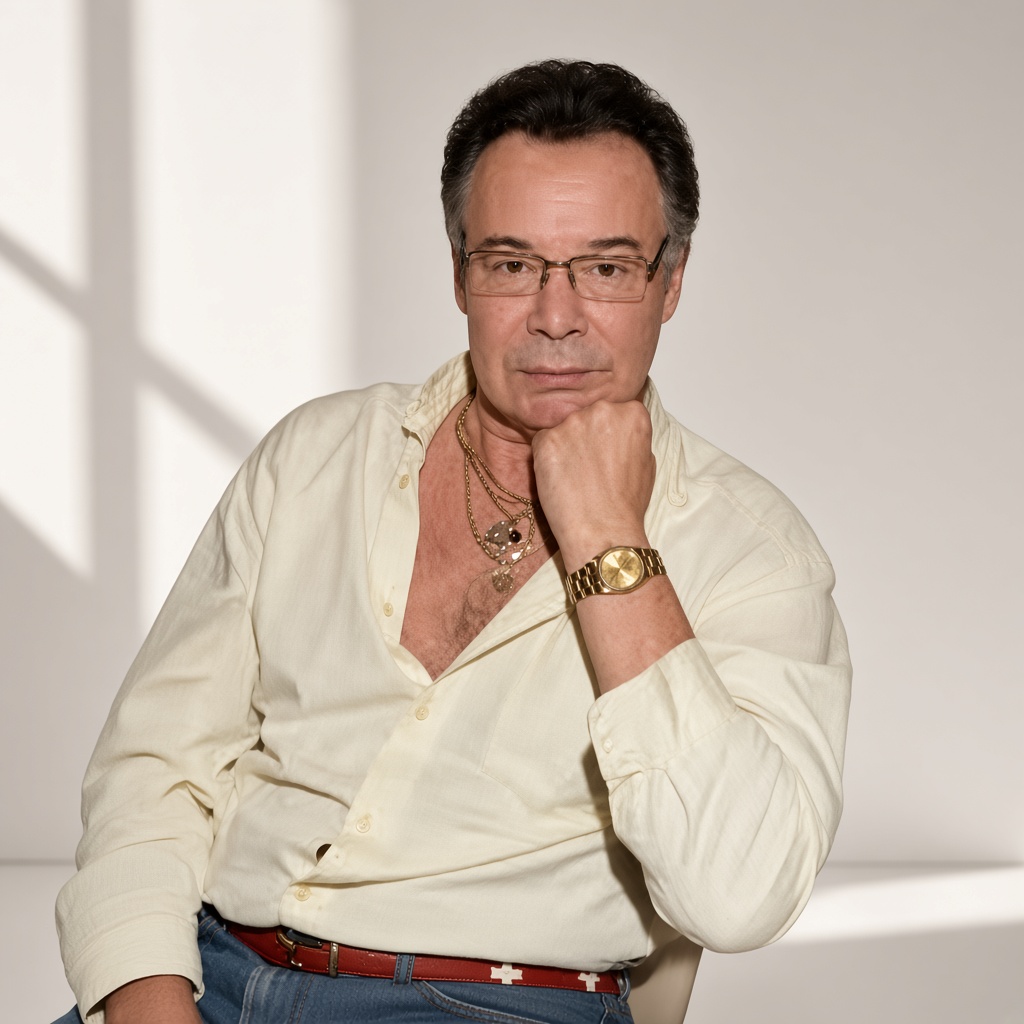
About Mikhail Muromov
Mikhail Vladimirovich Muromov was born in Moscow on 18 November 1950. His mother, Elena Rafikovna, half Tatar, headed a department of electrical engineering. His father, Vladimir Sergeevich, a hydraulics man and a senior researcher, went through the war. Mikhail himself says there was Buryat blood in his father and a distant kinship with Griboyedov. His parents split while he was a child. He finished a physics and mathematics school and a music school, in cello and guitar. He took a master of sport in swimming and a first rank in boxing. Later he said he had spent fifty-two hours in the water, received a medal for the fiftieth anniversary of Gagarin, and that the medal was carried off when the apartment was robbed. In 1969 he was taken on as guitarist and singer with the Slavs, and he sang there until 1972. He entered the Mendeleev chemical and technological institute, transferred in his second year to the technological institute of the meat and dairy industry, and finished it in 1971. In graduate school, by his own account, he made three instruments for the food industry and did not finish the degree. He went to work as a maitre d' in the expensive restaurants of Moscow and the towns around it, and he worked as a masseur at the Sanduny baths. In 1972 and 1973 he served in a sports company. With the restaurant money he bought one of the first synthesizers in Moscow and built a studio at home.
He came onto the big stage late, in 1985, when he was already past thirty. That year Moscow held the festival of youth and students, and the unofficial anthem was his Katyusha, The Hostess of the Festival, on words by Dzhuna Davitashvili. Two years later came Apples on the Snow. He wrote the music himself, and Andrey Dementyev gave the words. Muromov himself said he measured the song for a record at about three minutes and fifty seconds. At first it spread on cassettes, the disc came later, and in 1988 he was invited to sing it at Song of the Year. On the shelf the Russian list opens with those apples, 4 minutes 22 seconds, from the collection Winter Melody dated 1990. Beside them stands Ariadne: 6 minutes 3 seconds on one shelf, 4 minutes 42 seconds on another. A Strange Woman runs 6 minutes 51 seconds. The peak fell in 1987 to 1991. The words came from Dementyev, Rimma Kazakova, Larisa Rubalskaya, Anatoly Poperechny, Grigory Pozhenyan and Anatoly Sofronov.
He never saw the war in Afghanistan, and he wrote a cycle about it. On the shelf the album Afghanistan is dated 1994, fifteen songs: a risk zone, captains, ask the desert, Afghanistan itself, a late spring, the Orinoco, swallows, a letter to a brother, My Mother, The Earth Will Return to May, Awarded a Combat Order. The same year marks Salute, My Beloved: nights in Sochi, a blush, Venice, Malibu at 5 minutes 4 seconds, Fly Away, and the title salute at 5 minutes 18 seconds. He was married once, to Tamara Muromova, from 1973 to 1976. He himself names four sons born outside that marriage, from four women: Mikhail, Konstantin, Pavel and Arthur. He also said that at thirteen, with his mother's consent, he was intimate with her friends. After Igor Talkov was killed, he was among those who brought the body from Petersburg to Moscow. Svetlana Vragova called him into the theatre: eight of his songs sounded in a play, and then came work with Rustam Ibragimbekov. He counts twenty-five hours of theatre music and three ballets for himself.
In February 2020 he said that Alla Pugacheva had held his career back. He did not stop singing. On 18 November 2026 he turned seventy-six. Two days later, on 20 November, The Stewardess came out, fourteen songs. The title track is 4 minutes 3 seconds, then waiting for love, gambling, a bar, a cap, a bird with a blue wing, a witch, The Yellow Road at 4 minutes 32 seconds, a beloved dog, Freestyle, Stand Up and Sing, a short Don't Drink at 1 minute 51 second, a first and last love, and With You Again at 4 minutes 48 seconds. The apples still stand first. A Moscow boy with a cello, a restaurant wage and a synthesizer still sings the snow, Ariadne and a strange woman, and at seventy-six he adds a stewardess to them.

Comments